VET Workforce Research
This project aimed to develop an understanding of the VET workforce and the challenges associated with attracting and retaining people.

Overview
We conducted extensive research in collaboration with the people and organisations that deliver vocational education and training (VET) to ensure the sustainability of the current and future workforce. Our research allowed us to develop a comprehensive understanding of the VET workforce across the care and support sectors and the challenges associated with attracting and keeping people in those roles. Swipe or Click across the tabs to view active and completed project stages.
Final Report
The VET Workforce Report details key project outcomes, findings and recommendations with implications for HumanAbility, state, territory and federal governments, registered training organisations (RTOs) and industry.
It includes:
- detailed analysis of care and support VET workforce demographics, diversity and challenges
- findings from all three research phases
- design and pilot outcomes of an industry currency model and mentor framework
- comprehensive recommendations for government, RTOs, industry and HumanAbility
- appendices with detailed methodology, design principles, stakeholder roles and implementation guidance.
The report identifies priority areas for future research and support, and provides the evidence and recommendations that informed the development of:
- Industry Currency Toolkits: available for teachers, trainers and assessors (TTAs), RTOs and employers
- a VET Trainer and Assessor Mentoring Framework: designed in partnership with National Aboriginal Community Controlled Health Organisation (NACCHO) to support RTOs, managers and mentors.
Resources
- VET Workforce Report
- VET Workforce Report: Appendix D
- VET Workforce Report: Appendix E
- VET Workforce Report: Appendix G
- VET Workforce Report: Appendix H
- Industry Currency Toolkits
- VET Trainer and Assessor Mentoring Framework
- VET Trainer and Assessor Mentoring Framework: Mentoring Agreement
- VET Trainer and Assessor Mentoring Framework: Mentoring Checklist
- VET Trainer and Assessor Mentoring Framework fact sheet
Findings and Recommendations
Key Findings
The care and support VET workforce is predominantly female, skews older and is not as diverse as the student population. The workforce is deeply committed to its purpose but they are faces a challenging system. While many intend to stay working in their roles, there are risks in relying on personal motivation alone to support future workforce needs.
As part of a pilot program, we developed and tested practical solutions to address workforce recruitment and retention:
- Industry Currency Toolkits: RTO-Industry partnership model and toolkits for maintaining industry currency, which were co-designed with stakeholders and tested with 7 organisations across 4 states. The pilot showed that partnership-based approaches can strengthen industry currency and improve the relevance of teaching delivery
- VET Trainer and Assessor Mentoring Framework, designed in partnership with NACCHO to position mentoring as a developmental, strengths-based practice that supports capability building, professional identity, cultural safety, and workforce sustainability.
Recommendations
- Scale and adopt: tools and strategies that are already in place
- Build and reform: processes, pathways and workplace capability
- Investigate and evidence: where further research can inform future action.
Consultation
Maintaining industry currency through strengthened partnerships
Our VET workforce research was focused on attracting and retaining the VET workforce.
We co-designed a pilot and toolkit to support VET professionals in maintaining their industry currency, with an initial focus on the aged care and disability services sectors. Following this, we tested scalability with stakeholders across additional care and support sectors.
Over 12 weeks, we tested a pilot model and industry currency toolkit with industry employers and RTOs based in Northern Territory, New South Wales and Victoria.
Key dates for this phase of the research were:
- Co-design workshops and pilot development: November 2025 – February 2026
- Pilot delivery and Evaluation: February - May 2026
- Stakeholder testing: April 2026
- Analysis and report submission: May 2026 – June 2026
Designing a mentorship framework for newly qualified graduates of NACCHO's TAE program
We partnered with NACCHO to create a First Nation stream for the VET Workforce research project to help strengthen the First Nations VET workforce. As part of this work, we designed a mentorship framework for newly qualified graduates of NACCHO's First Nations Trainer and Assessor Demonstration program with a focus on cultural safety and effective mentoring practices.
NACCHO’s First Nations Trainer and Assessor Demonstration program provides wrap around support for professionals while they undertake the TAE40116 Certificate IV in Training and Assessment and it has already supported 40 First Nations health workers to complete the Certificate IV with culturally tailored training.
This important work forms part of our efforts to deliver against health, workforce and education targets in the Close the Gap strategy.
Past consultation
Thank you to everyone who took part in our consultations. Your insights have ensured our research aligns with and reflects industry and registered training organisation needs across HumanAbility sectors.
- Stream 1 of research: 3 x surveys, 9 x workshops, and 13 x interviews between October 2024 and April 2025. Report available under the Findings & Reccmmendations tab above.
- Stream 2 of research: Stakeholder interviews to test key prioritisation of key challenge areas
- Stream 3 of research: 13 x workshops, 10 x interviews between September and October 2025.
Project Overview
In 2024, the Australian Government released the VET Workforce Blueprint, which provides a roadmap to grow, support and sustain the VET workforce. One of the first actions included in the Blueprint was for HumanAbility to undertake a research project to understand the diversity and demographics of the VET care and support workforce, their key challenges, and practical solutions to support them.
The care and support sectors employ around one in five Australian workers and they are projected to grow faster than any other part of the economy. Working with VET professionals and stakeholders across all states and territories, HumanAbility conducted literature reviews, interviews, workshops and surveys to gather insights into VET workforce pathways, challenges, motivations and employee intentions to remain in their roles.
Our research found that people are willing and motivated to join the workforce. Despite navigating challenges such as growing administration and compliance responsibilities, a lack of career pathways, barriers to forming longstanding relationships with industry, and increasing student wellbeing responsibilities, the workforce is deeply committed to supporting students, building the sector workforce, and making a difference.
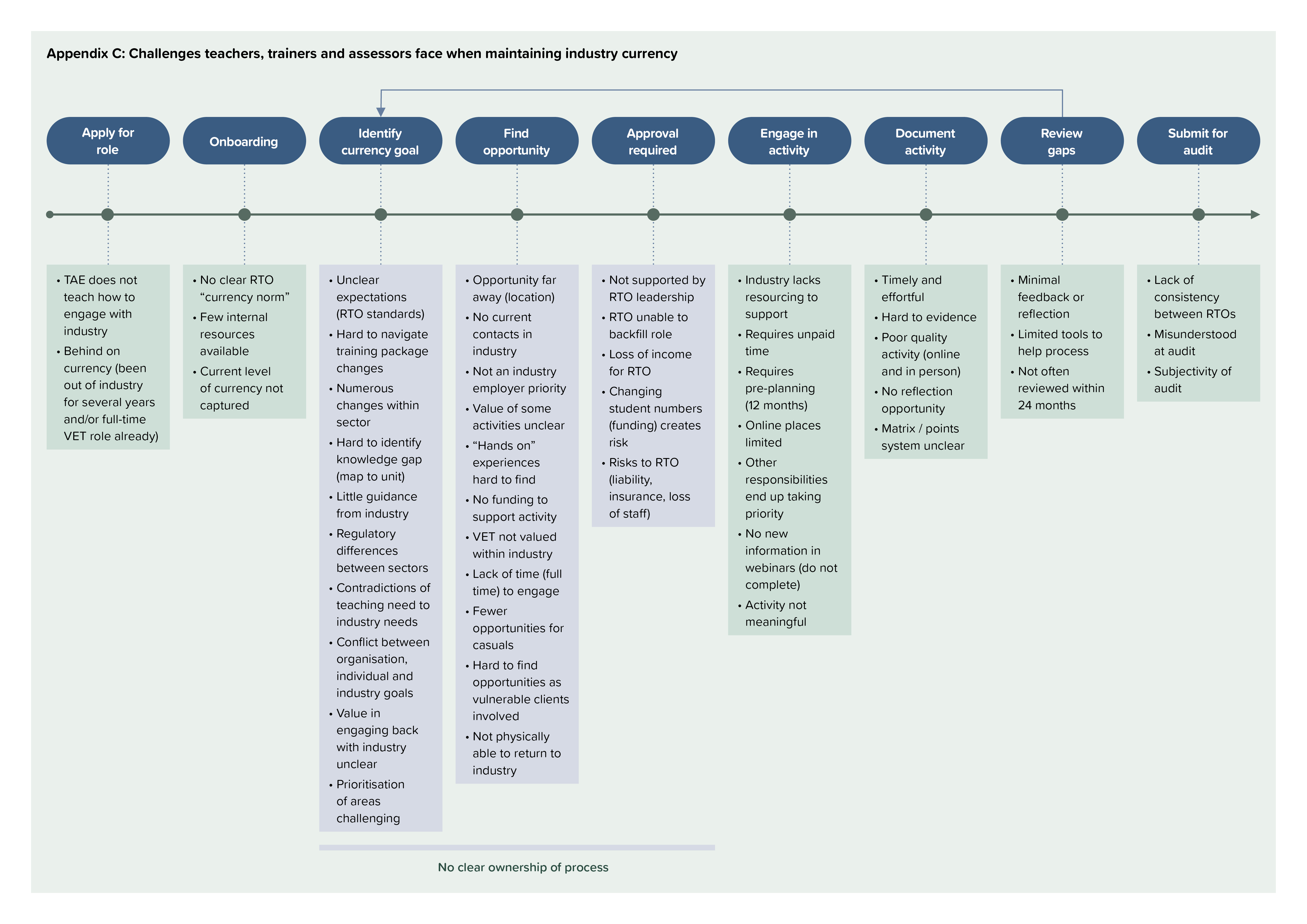
Following our initial findings, we co-designed and tested toolkits with stakeholders to help VET professionals maintain industry currency. Industry currency ensures TTAs have contemporary knowledge, skills and practices in their sector area, which is a requirement under the Standards for RTOs 2025. The pilot program resulted in the development of practical Industry Currency Toolkits.
Additionally, a VET Trainer and Assessor Mentoring Framework was created in partnership with NACCHO to support RTOs, managers and mentors when conducting mentoring programs, agreements, and everyday practices.
A three-stream approach to research
- Stream 1 (October 2024– June 2025): Undertake industry-specific VET workforce studies to develop a comprehensive understanding of industry-specific influences and roles in the VET workforce
- Stream 2 (July 2025 – September 2025): Investigate industry-specific VET workforce challenges and issues and identify industry-led responses
- Stream 3 (October 2025 – July 2026): Investigate and support industry specific VET workforce pathways and pipeline and identify industry-led actions
Snapshot report
Download Snapshot report
Progress report
Download Progress report
Final report resources
VET Workfotce report
VET Workforce Report: Appendix D